
Atmosphere: Structure & Composition
Content
- Introduction
- Composition of Atmosphere
- Role of Important Atmospheric Components
- Structure of Atmosphere
- Importance of Atmosphere
- Conclusion
- FAQs
Introduction
The atmosphere is the gaseous envelope surrounding the Earth, held close to the surface by gravitational force. It is an indispensable component of the Earth system because it sustains life, regulates temperature, protects the planet from harmful solar radiation, and facilitates weather and climate processes. Nearly 99% of the total atmospheric mass is concentrated within about 32 km above the Earth’s surface. The atmosphere is not uniform; it consists of a mixture of gases, water vapour, and suspended particles arranged in distinct layers based on variations in temperature and density.
Composition of Atmosphere
The atmosphere is primarily composed of gases. In dry air, nitrogen and oxygen together constitute nearly 99% of the total volume, while the remaining fraction consists of argon, carbon dioxide, ozone, helium, hydrogen, neon, and other trace gases. Besides gases, the atmosphere also contains water vapour and dust particles, which play a major role in weather and climatic phenomena.
Major Gases in the Atmosphere
| Gas | Percentage | Importance |
| Nitrogen | 78% | Essential for plant growth and protein formation; dilutes oxygen and controls rapid combustion |
| Oxygen | 21% | Necessary for respiration and combustion |
| Argon | 0.93% | Inert gas with little direct biological role |
| Carbon dioxide | ~0.04% | Important for photosynthesis and greenhouse effect |
| Other gases | Trace amount | Includes ozone, helium, neon, hydrogen, methane etc. |
Role of Important Atmospheric Components
Nitrogen is the most abundant gas in the atmosphere. Although it is relatively inactive, it is essential for living organisms because it forms a key component of proteins and plant nutrients. It also reduces the intensity of combustion by diluting oxygen.
Oxygen is the second most abundant gas and forms the basis of life processes. It is indispensable for respiration in living organisms and supports combustion.
Carbon dioxide exists in small quantity but plays a disproportionately significant role. It absorbs terrestrial radiation and helps maintain Earth’s temperature through the greenhouse effect. It is also vital for photosynthesis, through which plants prepare food.
Ozone is concentrated mainly in the stratosphere between 10-50 km above Earth’s surface. It acts as a protective shield by absorbing harmful ultraviolet (UV) radiation from the Sun.
Water vapour is highly variable in quantity and may constitute up to 4% of atmospheric volume in humid regions. It decreases rapidly with altitude. Water vapour is the source of all forms of precipitation and is also an important greenhouse gas.
Dust particles include smoke, pollen, sea salts, and fine soil particles. These particles are concentrated mainly in lower atmospheric layers and act as nuclei around which water droplets condense to form clouds.
Structure of Atmosphere
The atmosphere is vertically divided into different layers based on temperature characteristics. Each layer has distinct physical properties and performs specific functions important for Earth’s environment.
Troposphere
The troposphere is the lowest and most important layer of the atmosphere because all weather phenomena occur within it. Its average height is about 13 km, though it extends up to nearly 18 km near the equator and only about 8 km near the poles. The layer is thicker at the equator due to intense convectional uplift caused by higher temperatures.
About 75-80% of the total atmospheric mass and almost all water vapour and dust particles are concentrated in this layer. As altitude increases, temperature decreases at an average lapse rate of about 6.5°C per 1000 metres. Clouds, rainfall, storms, cyclones, and other atmospheric disturbances are largely confined to the troposphere.
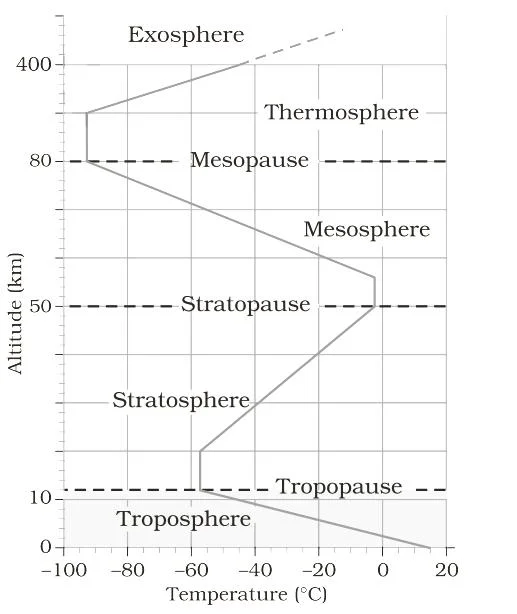
Tropopaus: The upper boundary of the troposphere is known as the tropopause. It separates the troposphere from the stratosphere. Temperatures here may reach nearly –80°C over the equator and around -45°C over the poles.
Stratosphere
The stratosphere extends from the tropopause up to nearly 50 km above Earth’s surface. Unlike the troposphere, temperature in this layer increases with altitude because ozone absorbs ultraviolet radiation and releases heat.
The most important feature of this layer is the ozone layer, which protects life on Earth from harmful UV rays. The stratosphere contains very little water vapour and is almost free from weather disturbances, making it comparatively stable. Jet aircraft commonly fly in the lower stratosphere because of the absence of turbulent weather conditions.
Stratopause: The upper limit of the stratosphere is called the stratopause.
Mesosphere
The mesosphere lies between 50 km and 80 km above Earth’s surface. In this layer, temperature once again decreases with altitude. The upper part of the mesosphere is considered the coldest region of Earth’s atmosphere, with temperatures dropping to nearly -90°C.
Most meteors entering Earth’s atmosphere burn up in this layer due to friction with atmospheric particles. Rare noctilucent clouds, also called night-shining clouds, may form in the upper mesosphere.
Mesopause: The upper boundary of the mesosphere is called the mesopause.
Thermosphere
The thermosphere extends roughly from 80 km to 700 km above Earth’s surface. Temperature rises sharply in this layer because high-energy solar radiation is absorbed by sparse gas molecules.
A significant part of the thermosphere is the ionosphere, which contains electrically charged particles called ions. These ions reflect radio waves back to Earth, making long-distance wireless communication possible.
The ionosphere is divided into D, E, and F layers, though these are not sharply separated and vary with time and season. The thermosphere is also the region where auroras, Aurora Borealis in the Northern Hemisphere and Aurora Australis in the Southern Hemisphere are observed.
The International Space Station (ISS) orbits within this layer.
Exosphere
The exosphere is the outermost layer of the atmosphere and extends from about 700 km to nearly 10,000 km above Earth’s surface. In this region, atmospheric gases become extremely sparse and gradually merge with outer space.
Because molecular density is extremely low, particles can escape Earth’s gravitational pull from this layer. The lower boundary of the exosphere is called the exobase.
Importance of Atmosphere
The atmosphere is fundamental to life and environmental stability on Earth. It supplies essential gases for life processes, regulates Earth’s temperature, protects against harmful solar radiation, and burns up meteors before they reach the surface.
It also enables weather systems, rainfall, and climatic conditions necessary for agriculture and ecosystems.
Conclusion
The atmosphere is a dynamic and life-supporting system composed of gases, water vapour, and suspended particles arranged in distinct layers. Each atmospheric layer performs specialized functions, from weather formation in the troposphere to protection against ultraviolet radiation in the stratosphere and communication support through the ionosphere. Understanding the structure and composition of the atmosphere is essential for studying climate, environmental processes, and human interaction with the Earth system.
FAQs
Q1. What is the atmosphere?
The Atmosphere is the envelope of gases surrounding the Earth, held by gravity, which protects life and regulates climate.
Q2. What is the composition of the atmosphere?
The atmosphere mainly consists of:
Nitrogen (78%)
Oxygen (21%)
Argon, carbon dioxide, and trace gases
It also contains water vapour, dust particles, and aerosols.
Q3. What are the major layers of the atmosphere?
The atmosphere is divided into:
Exosphere
Troposphere
Stratosphere
Mesosphere
Thermosphere
Q4. What is the importance of the troposphere?
The Troposphere is the lowest layer where most weather phenomena, clouds, and human activities occur.
Q5. Why is the stratosphere important?
The Stratosphere contains the ozone layer, which absorbs harmful ultraviolet radiation from the Sun.
Click on the question to see the Answers
Visit LevelUp IAS- Click Here