
Mains Articles
Formation of the Indian National Congress
Content Introduction Background Formation of Indian National Congress Objectives of the Indian National Congress Nature and Composition Theories Regarding the Formation Significance of the Formation of INC Important Sessions Conclusion FAQs Introduction The formation of the Indian National Congress…
Content
- Introduction
- Background
- Formation of Indian National Congress
- Objectives of the Indian National Congress
- Nature and Composition
- Theories Regarding the Formation
- Significance of the Formation of INC
- Important Sessions
- Conclusion
- FAQs
Introduction
The formation of the Indian National Congress in 1885 marked a turning point in the history of modern India. It provided, for the first time, an organised all-India political platform through which educated Indians could collectively express their political, economic, and administrative grievances against British rule. Over time, the Congress transformed from a moderate pressure group into the principal organisation leading India’s national movement.
The establishment of the Congress was not an isolated event. It was the culmination of various socio-religious reforms, political associations, spread of Western education, rise of nationalism, and increasing dissatisfaction with colonial rule during the second half of the nineteenth century.
Background of Formation of INC
During the nineteenth century, British rule led to significant political and economic changes in India. While the colonial administration introduced modern education, railways, telegraph, and a unified administrative structure, it also resulted in economic exploitation, racial discrimination, and political exclusion of Indians.
Educated Indians gradually realised that despite promises of liberal governance, the British administration primarily functioned to safeguard imperial interests. Several factors contributed to the rise of nationalist consciousness:
Growth of Western Education
The spread of English education exposed Indians to the ideas of liberty, equality, democracy, nationalism, and constitutional government. Educated Indians began comparing British liberal ideals with the realities of colonial exploitation in India.
Economic Exploitation
Indian intellectuals such as Dadabhai Naoroji highlighted the “Drain of Wealth” from India to Britain. Heavy taxation, destruction of indigenous industries, and recurring famines intensified resentment against colonial rule.
Development of Means of Communication
Railways, postal services, newspapers, and telegraph connected different regions of India and facilitated political awareness and national integration.
Role of Press and Literature
Newspapers like Amrita Bazar Patrika, The Hindu, and Kesari played an important role in spreading nationalist ideas and criticising colonial policies.
Rise of Political Associations
Before the formation of the Congress, several regional political organisations emerged, including:
- Indian Association (1876) by Surendranath Banerjea
- Bombay Presidency Association
- Madras Mahajan Sabha
- Poona Sarvajanik Sabha
These organisations demanded greater Indian participation in administration and laid the foundation for an all-India political body.
Formation of Indian National Congress
Although many Indian leaders had been contemplating the creation of a national political organisation, it was Allan Octavian Hume, a retired British civil servant, who gave the idea a concrete organisational form.
Hume consulted leading Indian intellectuals and political workers and organised the first session of the Congress in December 1885.
Initially, the meeting was proposed to be held at Poona under the name “Indian National Union,” but due to a cholera outbreak, the venue was shifted to Bombay.
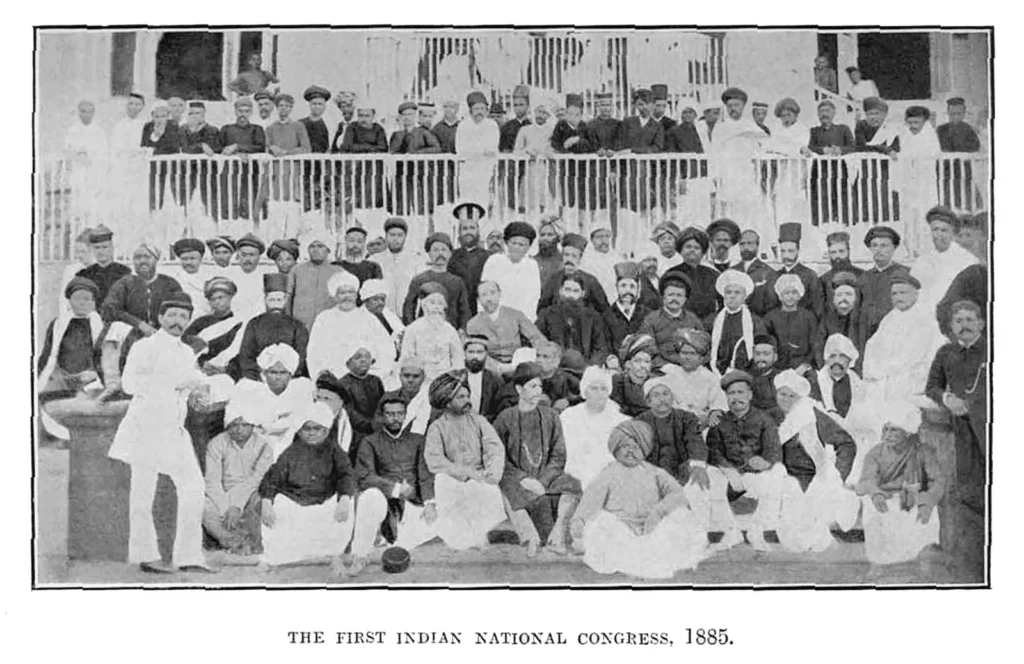
The first session of the Congress was held on 28 December 1885 at the Gokuldas Tejpal Sanskrit College, Bombay.
The session was presided over by Womesh Chandra Bonnerjee.
A total of 72 delegates from different parts of India attended the session, symbolising the beginning of organised nationalist politics at the national level.
Objectives of the Indian National Congress
The early Congress leaders adopted moderate and constitutional methods. The objectives of the Congress were clearly defined by W.C. Bonnerjee during the first session.
The organisation aimed to promote close relations among politically conscious Indians from different regions and communities. It sought to eradicate prejudices based on caste, religion, and province and develop a sense of national unity.
Another important objective was to formulate public opinion on important political and administrative issues and present Indian demands before the British government through constitutional means such as petitions, resolutions, and debates.
Thus, in its initial phase, the Congress acted as a political platform for educated Indians seeking administrative reforms and greater participation in governance.
Nature and Composition of the Early Congress
The early Congress was dominated mainly by educated middle-class professionals such as lawyers, teachers, journalists, and doctors. Lawyers constituted a particularly influential group within the organisation.
The Congress did not initially attract large participation from peasants, workers, artisans, or princely rulers. Many zamindars and princes remained distant because they feared that liberal and nationalist politics could weaken their privileges.
Despite its limited social base, the Congress played a crucial role in creating political consciousness and laying the foundation for a pan-Indian nationalist movement.
Theories Regarding the Formation of INC
Historians have debated the reasons behind the formation of the Congress. Several theories have been proposed to explain its origin.
Safety Valve Theory
According to this theory, A.O. Hume founded the Congress as a “safety valve” to channel the growing dissatisfaction among educated Indians into constitutional methods and thereby prevent violent rebellion against British rule.
This theory was supported by extremist leaders such as Lala Lajpat Rai.
The British administration feared that rising political unrest could threaten colonial stability, and therefore encouraged a moderate political platform.
Conspiracy Theory
The Marxist historian Rajani Palme Dutt developed the conspiracy theory from the safety valve concept.
According to him, the Congress was created as part of a deliberate strategy to suppress revolutionary tendencies and protect British imperial interests by keeping nationalist politics within moderate limits.
Lightning Conductor Theory
Gopal Krishna Gokhale proposed the “Lightning Conductor Theory.”
According to this interpretation, politically conscious Indians themselves desired an all-India political organisation, and Hume merely acted as a catalyst who helped unite nationalist forces.
Modern historians generally consider this interpretation more balanced because Indian nationalism had already been developing through regional political associations and intellectual movements before 1885.
Significance of the Formation of INC
The formation of the Congress had immense historical significance.
It transformed scattered political activities into a coordinated national movement. For the first time, Indians from different linguistic, regional, and religious backgrounds assembled on a common political platform.
The Congress promoted the idea of Indian nationhood and gradually developed a sense of political unity among Indians.
It also trained generations of political leaders in constitutional methods, public debate, and mass mobilisation.
Most importantly, the Congress eventually became the principal organisation leading India’s freedom struggle against British colonialism.
Important Sessions of the Indian National Congress
| Year & Place | President | Important Outcomes |
| 1885 -Bombay | W.C. Bonnerjee | Formation of INC; first session attended by 72 delegates |
| 1886 -Calcutta | Dadabhai Naoroji | Decision to establish Provincial Congress Committees |
| 1887 -Madras | Badruddin Tyabji | First Muslim President of INC |
| 1888 -Allahabad | George Yule | First English President of INC |
| 1889 -Bombay | Sir William Wedderburn | Resolutions on education, agriculture, and Congress creed |
| 1901 -Calcutta | Dinshaw Eduljee Wacha | First appearance of Mahatma Gandhi on Congress platform |
| 1905 -Banaras | Gopal Krishna Gokhale | Opposition to Partition of Bengal; support for Swadeshi |
| 1906 -Calcutta | Dadabhai Naoroji | Adoption of Swaraj as the goal |
| 1907 -Surat | Rash Behari Ghosh | Surat Split between Moderates and Extremists |
| 1916 -Lucknow | Ambica Charan Mazumdar | Lucknow Pact; reunion of Moderates and Extremists |
| 1917 -Calcutta | Annie Besant | First woman President of INC |
| 1920 -Calcutta (Special Session) | Lala Lajpat Rai | Approval of Non-Cooperation Movement |
| 1920 -Nagpur | C. Vijayaraghavachariar | Reorganisation of Congress on linguistic basis |
| 1923 -Delhi (Special Session) | Maulana Mohammad Ali | Acceptance of council entry by Congressmen |
| 1924 -Belgaum | M.K. Gandhi | Only session presided over by Gandhi |
| 1925 -Kanpur | Sarojini Naidu | First Indian woman President of INC |
| 1929 –Lahore | Jawaharlal Nehru | Adoption of Purna Swaraj resolution |
| 1931 – Karachi | Vallabhbhai Patel | Resolution on Fundamental Rights and National Economic Programme |
| 1936 -Lucknow | Jawaharlal Nehru | Emphasis on socialism and economic upliftment |
| 1937 -Faizpur | Jawaharlal Nehru | First rural session of Congress |
| 1938 -Haripura | Subhas Chandra Bose | Formation of National Planning Committee |
| 1939 -Tripuri | Subhas Chandra Bose | Bose resigned after conflict with Gandhi group |
| 1946 -Meerut | J.B. Kripalani | Acceptance of Cabinet Mission Plan |
| 1948 -Jaipur | Pattabhi Sitaramayya | Post-independence organisational restructuring |
Conclusion
The formation of the Indian National Congress in 1885 marked the beginning of organised nationalist politics in India. Although the early Congress adopted moderate methods and represented mainly educated elites, it successfully created political awareness and national unity across the country.
Over the following decades, the Congress evolved into a mass movement under leaders such as Bal Gangadhar Tilak, Mahatma Gandhi, Jawaharlal Nehru, and Subhas Chandra Bose, ultimately leading India toward independence in 1947.
Thus, the formation of the INC laid the institutional and ideological foundation of the Indian national movement and occupies a central place in the history of modern India.
FAQs
Q1. When was the Indian National Congress (INC) formed?
The Indian National Congress was formed in 1885.
Q2. Who founded the Indian National Congress?
The INC was founded with the initiative of Allan Octavian Hume, along with support from Indian leaders.
Q3. Where was the first session of the INC held?
The first session was held at Bombay (now Mumbai) at Gokuldas Tejpal Sanskrit College.
Q4. Who presided over the first session of the INC?
Womesh Chandra Bonnerjee presided over the first session.
Q5. What were the objectives behind the formation of the INC?
The objectives included:
Increasing participation of Indians in administration
Creating a platform for political dialogue
Promoting national unity
Presenting Indian grievances before the British government
Click on the question to see the Answers
Visit LevelUp IAS- Click Here
Related reads.
Salient Features of India for UPSC: Complete Notes
14 May 2026 1 min
Civil Disobedience Movement (1930)
14 May 2026 9 min
Non-Cooperation Movement (1920-1922)
13 May 2026 8 min
Social Sector and Services for UPSC: Complete Notes
13 May 2026 1 min
Home Rule Movement (1916-1918)
12 May 2026 7 min
Role of Civil Services for UPSC: Complete Notes
11 May 2026 1 min
Put it into practice
Reading is step one.
Turn what you've just read into exam-ready answers with mentor-led practice and our structured test series.